A Technical Deep Dive: Quantifying the Impact of Secondary Air on DLE Combustor Emissions

Dr. Bassam Abdelnabi
Principal Consultant, Gas Turbine Combustion Expert
Introduction: The Overlooked Variable in Emissions Control
The central challenge in modern Dry Low Emissions (DLE) combustion systems is the continuous drive to reduce Nitric Oxide (NOx) emissions while simultaneously managing critical operational constraints, such as the hardware cooling required for system durability. A key component of this balance is the use of "secondary air", the portion of the total combustor airflow used for cooling, dilution, and managing leakage, which is distinct from the primary air that flows through the fuel-air premixer.
While common engineering practice relates emissions performance to the theoretical mixer flame temperature (Tflame), the direct influence of this secondary air is not well-quantified in published literature. This represents a significant knowledge gap for designers aiming for single-digit NOx levels.
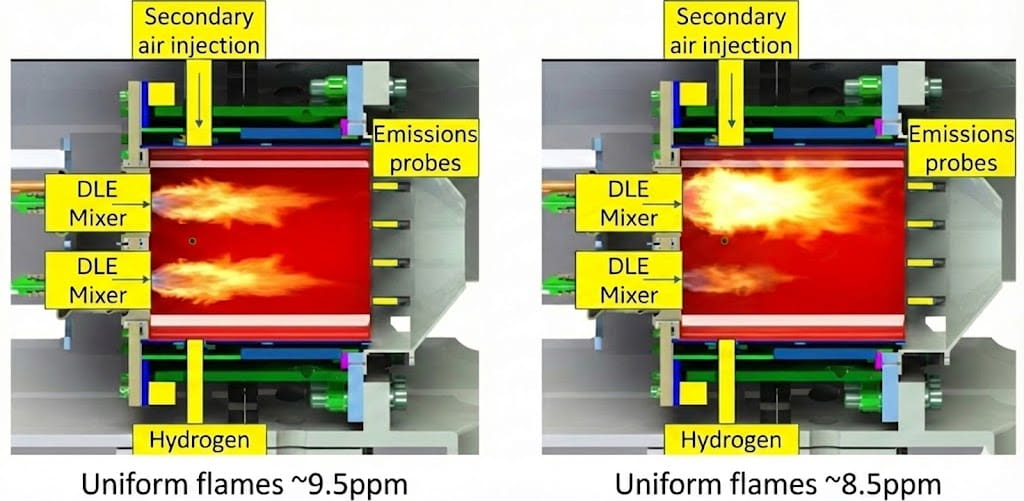
This article presents a detailed analysis of a study that experimentally quantifies the impact of varying secondary air percentage on emissions, flame interaction, and thermo-acoustic stability. The experiments were conducted under the high-pressure, high-temperature conditions representative of an H class gas turbine, providing a practical and data-driven perspective on this critical design variable.