Transitioning DLE Combustion Systems to 100% Hydrogen Operation

Dr. Bassam Abdelnabi
Principal Consultant, Gas Turbine Combustion Expert
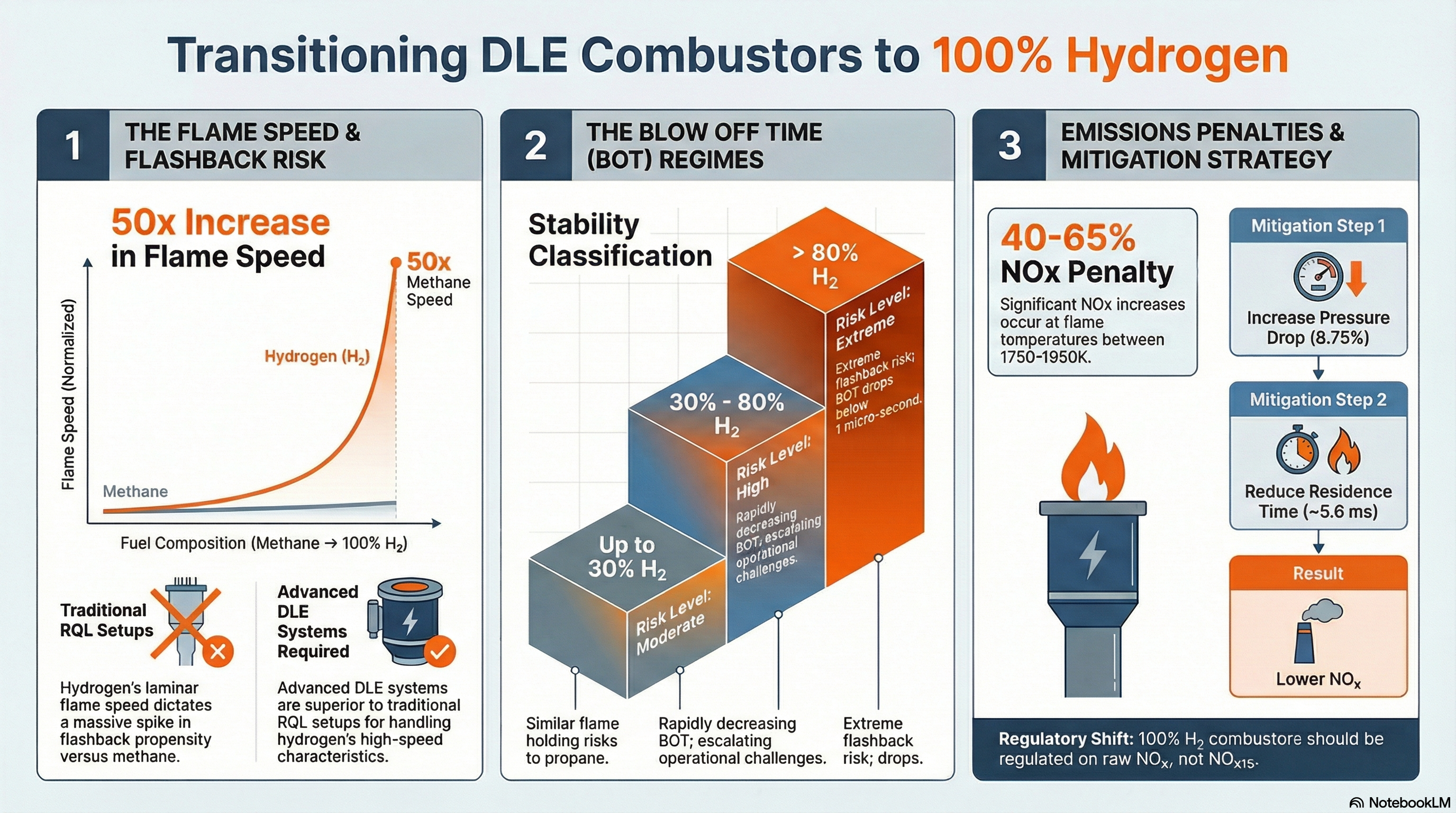
1. The Physics of Hydrogen Transition: Flame Speed and Flashback Propensity
As the energy sector moves toward a hydrogen economy, the aerospace and power generation sectors face a fundamental strategic necessity: redefining the kinetic boundaries of existing gas turbine hardware. Central to this transition is the understanding of laminar flame speed (SL). For a Principal Engineer, SL is not merely a laboratory metric; it is the primary determinant of hardware safety and the "kinetic firewall" against catastrophic failure. In the transition from Natural Gas (methane) to Hydrogen, SL dictates how quickly the fuel-air mixture is consumed and, crucially, whether the flame can propagate upstream into the injection hardware, an event known as flashback.
Research using the Cantera perfectly stirred reactor (PSR) network model reveals that hydrogen's laminar flame speed can be up to 50 times higher than that of methane. This massive increase fundamentally alters the risk profile for industrial mixers. As the equivalence ratio (φ) increases, the ratio of hydrogen flame speed to methane flame speed rises sharply, indicating that richer mixtures are exponentially more susceptible to flashback and flame-holding events.
When evaluating combustion architectures, Dry Low Emissions (DLE) systems demonstrate a clear strategic advantage over Rich-Quench-Lean (RQL) or diffusion-based systems. DLE systems typically operate at low equivalence ratios (often φ < 0.75), where the increase in flame speed is significantly more modest compared to the high-equivalence-ratio zones inherent in RQL designs. By maintaining a lean environment, DLE hardware provides a higher margin of safety against hydrogen-related flashback. However, while steady-state flame speeds define the boundaries of operation, the transient risks of flame holding must be quantified using the Blow Off Time (BOT) metric.