Decoding the Vortex: A Technical Deep-Dive into Breakdown Dynamics and Stability

Dr. Bassam Abdelnabi
Principal Consultant, Gas Turbine Combustion Expert
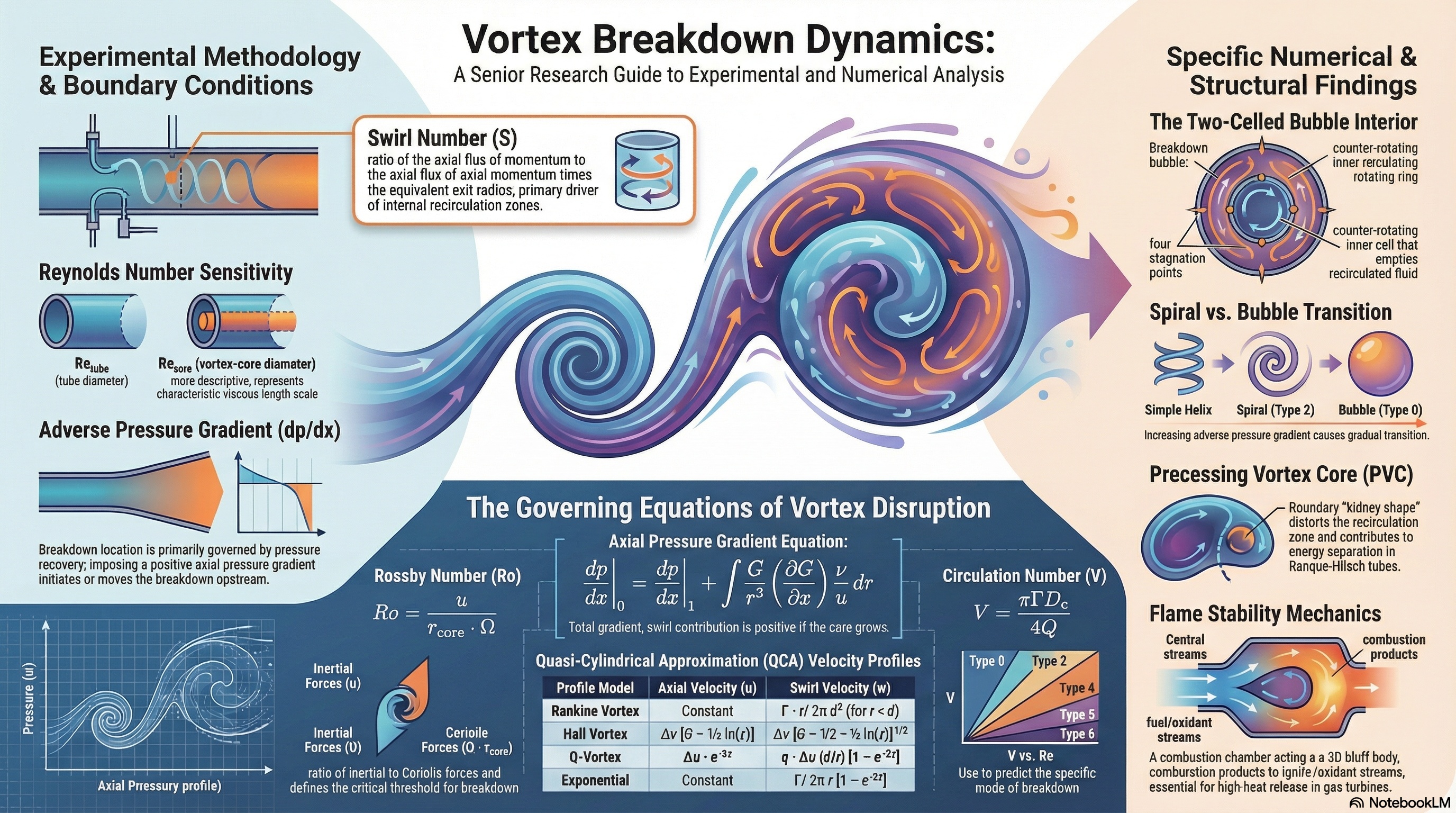
1. Introduction: The Mechanics of the "Vortex Breakdown"
In the rigorous analysis of high-speed fluid mechanics, "vortex breakdown" is defined as a abrupt and drastic change in the structure of a swirling flow. As fundamentally articulated by Leibovich, this phenomenon is initiated by specific variations in the tangential-to-axial velocity ratios. Physically, it manifests as a sudden retardation of the axial flow, culminating in the formation of stagnation points and complex recirculation zones.
The engineering relevance of vortex breakdown is bifurcated. In aeronautical applications, it represents a catastrophic stability hazard; for instance, the breakdown of leading-edge vortices on delta wings, governed by the angle of attack, can cause a sudden shift in the aerodynamic center and loss of lift. Conversely, in the propulsion sector, breakdown is an essential mechanism for flame stabilization. The resulting internal recirculation zone (IRZ) acts as a high-temperature aerodynamic bluff body, ensuring continuous ignition and stable heat release in high-intensity combustion systems. This synthesis evaluates the mechanical thresholds, numerical evolution, and enstrophy intensification associated with this transition, drawing upon 45 years of experimental and computational research.